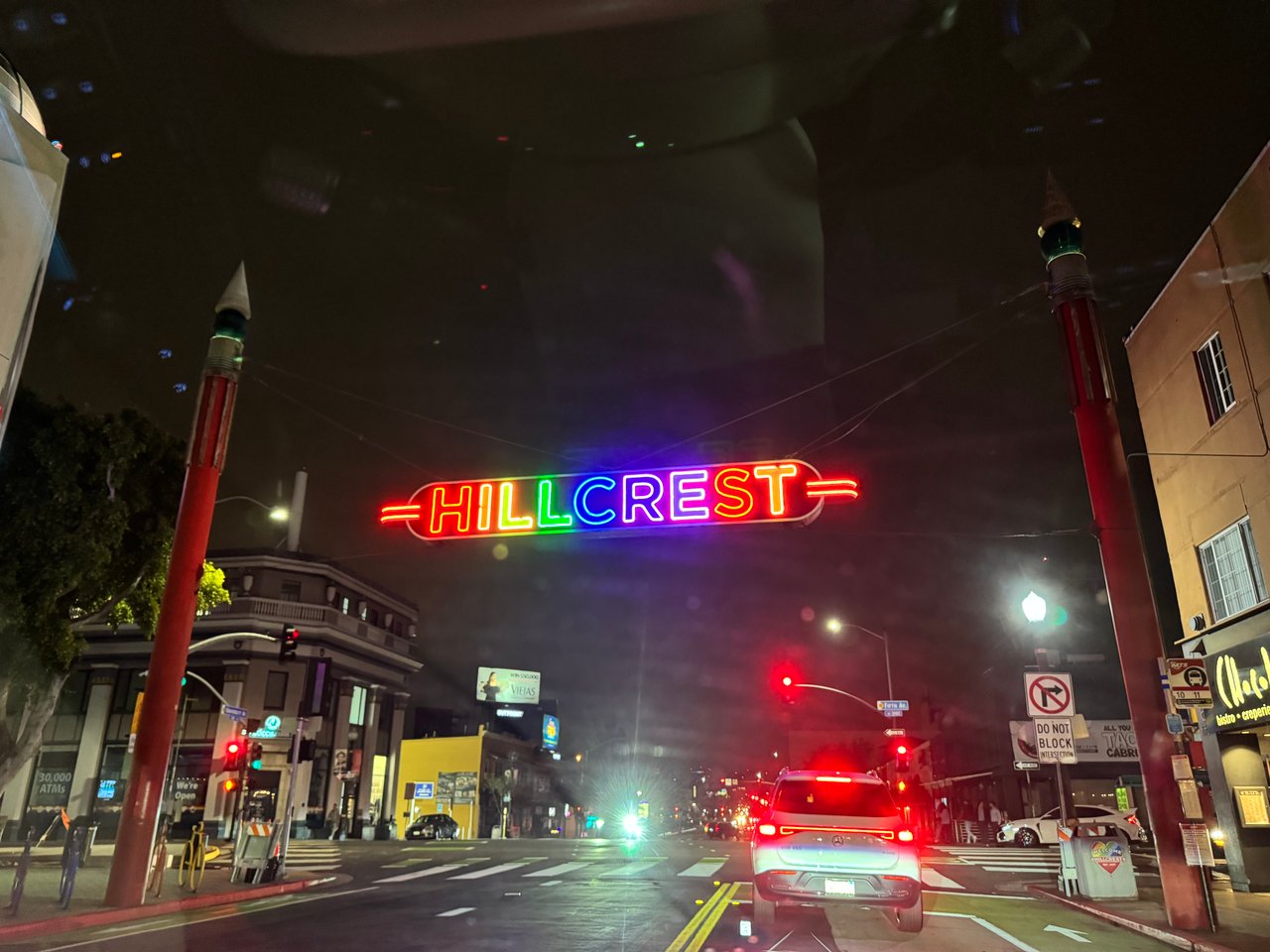
Pride weekend ended July 19. CityFest lands on Fifth Avenue on August 9. In the twenty-one days between them, Hillcrest is doing something a resident who walks these blocks daily can feel but not quite name: the neighborhood is running its 2027 program on its 2024 map, because the piece of ground that was supposed to hold the middle of everything is still fenced off.
That gap, and how the corridor has adjusted around it, is the story of August in Hillcrest this year.
The Fence That Redirected the Neighborhood
The Pride Promenade on Normal Street began construction in February 2025 with an 18-month timeline aimed at San Diego Pride 2026. That deadline slipped. Construction on the Pride Promenade in Hillcrest looking north from University Avenue on July 21, 2026 still requires imagination for what the finished project will look like; the promenade began as part of the Uptown Community Plan back in 1988, and 38 years later it is just months away from being finished. KPBS reported in late July that the underground work is now complete and the surface build-out is what remains.
Cost and scale matter here because they explain why the disruption has been tolerable to the businesses on the block. The project is jointly funded by the city and SANDAG at an estimated cost of nearly $28 million, and once finished it will cost about $600,000 a year to manage the promenade. The design elements now visible on-site tell you what the block will read like when it reopens:
Element | Detail |
|---|---|
Trees planted | ~100, with a target near 115 at completion |
New parking spaces | 50+ (a net gain, unusual for a bike project) |
Traffic lanes on Normal | Reduced from four to two total |
Anchor structure | Restored avocado-green trolley car as café and info booth |
Bike lane | Painted in Pride rainbow colors, linking University to Howard |
Storm drainage | Rebuilt to connect University Ave storm drains to Normal Street's, addressing chronic flooding at the intersection |
Ben Nicholls, executive director of the Hillcrest Business Association, has framed the delay in terms residents will recognize from any older San Diego block. He described a patchwork of interests solving many problems at once, many of which were discovered after construction began, like aging infrastructure underground. Brittany Bailey from Mayor Todd Gloria's office, who is managing the project, told reporters the crews are correcting old piping that never properly connected the two storm systems.
The cost of the delay has been real for the businesses closest to the fencing. Cellar Hand, Hillcrest Brewing Company, and the other shops in the corner plaza off University Avenue and Normal Street have struggled since construction began, with Hillcrest Brewing Company seeing business drop 20% last year and Cellar Hand estimating a 25 to 30 percent reduction in revenue. Mostra Coffee, on Normal itself, has taken the sharpest hit; its area manager told NBC 7 that days of $3,000 in revenue have become days of $300 to $400.
Two things follow from that. First, if you live here and you have not walked into Cellar Hand or Mostra in a while, they need you now, not in December. Second, the businesses that survive the fence period will inherit a rebuilt block with 50 more parking spaces and a park anchoring their front door. That is a very unusual reward structure in San Diego commercial retail, and it explains the tenor of the operators who have opened during the disruption rather than after it.
What Opened While Normal Street Was Closed
The list of 2024 through 2026 openings on Fifth Avenue, University, and Park Boulevard is long enough that the neighborhood's dining floor has quietly reset while attention was on the fencing. A partial map, all within a fifteen-minute walk of the Pride Flag:
Rocko's Modern Taphouse opened in early 2026 at 3940 Fourth Avenue, on the second floor across from Scripps Mercy. It is a 90s-inspired taproom and arcade, seven days a week, with weekend brunch and a plan to add weekday lunch as the hospital workforce discovers it. With Scripps Mercy Hospital across the street plus plenty of other offices and businesses, ownership expects to add lunch hours by summertime because people are going to need a place to take their break.
Origen, from co-founders Franco Mestre and Sebastian Berho, took the former XOXO Diner space at 3831 Park Boulevard and brought a coastal Mexican menu into a room that had been dark for years. Frenchy's Hideout, Michael Simpson's California-meets-France wine bar at 142 W University Avenue, opened last spring and returned for its second Taste of Hillcrest in April. Pastiamo, a build-your-own pasta concept on University, and Schmackary's, the New York cookie shop with what one local guide called the most aggressive cookie flavor rotation in Uptown, both landed this year. DASHI on Fifth brings a moody, plated modern Japanese room to a block that has traded on Italian and American for two decades.
Set those against the corridor's long anchors, which have not moved: Trust on Park Boulevard, Common Stock at 3805 Fifth, Parma Cucina Italiana at 3850 Fifth, insideOUT at 1642 University, Rakitori at 530 University, Ichiban at 1449 University (Japanese-owned and open since 1981), Khyber Pass at 523 University (over 30 years in Hillcrest), Great Maple at 1451 Washington. That mix is the neighborhood's actual character: deep-rooted operators holding the floor while newer money bets on the ceiling.
The August 9 Test
CityFest arrives on Sunday, August 9, from noon to 11 p.m., taking Fifth Avenue for its 40th year. The 40th annual celebration will feature live bands, electric dance music DJs, arts, crafts, and food, and typically attracts over 50,000 visitors from San Diego and Southern California. The scale matters less than the geography. With Pride Plaza still fenced and Normal Street off the map, CityFest is functioning as a preview of the block Hillcrest will inhabit when the Promenade opens: pedestrian-first, spilling from Fifth onto the side streets, forcing the new operators to prove they can hold a crowd without the Pride flag anchoring the flow.
Trust, Common Stock, Parma, and DASHI sit directly on the CityFest footprint on Fifth. Rocko's is a block off. Origen and Frenchy's Hideout will pull the eastern end. Watch which rooms are full at 3 p.m. and which are full at 9. That answers a question about the corridor's future occupancy that no market report can.
A Sunday Morning, Rerouted
The Hillcrest Farmers Market has been in exile from Normal Street since January 26, 2025. It now takes place on University Ave from Herbert St to Park Blvd and on Center St from University to Harvey Milk, with Center St closed to through traffic while resident parking access remains open. Sundays run 9 a.m. to 2 p.m., year-round, with roughly 175 vendors and about 10,000 weekly visitors.
A resident Sunday in early August, rerouted around the fencing:
- Coffee at Mostra on Normal by 8:45 before the market crowd arrives, or at Cellar Hand if you want to sit.
- Farmers Market on University between Herbert and Park from 9 to 11, hitting the produce runs early.
- Late breakfast at Great Maple on Washington or Snooze in the corridor to the west.
- Walk south down Sixth toward Balboa Park while the parade route still feels like a route, before it reverts to a street.
- Dinner at Trust, Origen, or DASHI, depending on the mood.
That sequence is the neighborhood's answer to itself. The Promenade will replace step 1 and step 2 with a single stop once it opens, which is precisely why the businesses on Normal are trying to hold on until then.
What This Adds Up To
The reason August in Hillcrest feels different this year is not Pride, and it is not the openings, and it is not CityFest. It is that a neighborhood which never had a public gathering space is watching one get built while operating without one. The Promenade is hailed as the first public recreation space in Hillcrest, which has no parks. Every business on the corridor is making a bet about what the block reads like once that piece is finally in place.
For a resident, the practical read is this. The rooms opening now are pricing themselves for the pre-Promenade corridor and will still be here at the same addresses when the fencing comes down. The rooms that have been here for thirty years are still the load-bearing walls of the neighborhood, and they need traffic through the summer. And the CityFest footprint on August 9 is the closest thing to a rehearsal for the post-Promenade Hillcrest that the block will get before late 2026.
If you own here and are thinking about what the next chapter looks like for your property once Normal Street reopens, or if you are watching the corridor from further out and want a read on how the rebuilt block will price against comparable urban neighborhoods, Jeff Davidson Group is happy to walk the block with you. Contact us when you are ready.
Jeff Davidson Group | Pacific Sotheby's International Realty
Jeff Davidson, Broker Associate | CA DRE: 01165106
619.855.7300 | [email protected]